How to run Image generation AI with eudaimonia?
Quick guide to setup comfyui on your computer and generate images with a model (pony)
This feature allows you to play a session (normal or EstimAI) with your favourite character. When enabled, it will generate in real-time images that complement the session with the character you've picked.
You can create and customize multiple characters in anime or realistic style. It has been developed with Pony models in mind for their performances, flexibility and lewd capabilities.
In the future I hope to be able to generate images that correspond as closely as possible to what's happening in the session (character's position, face's expression, background, etc.).
An account is required to use this feature, you can signup here.
You can manage your characters here.
Video
What do I need to run this?
You'll need 4 things:
- At least 8go available VRAM (which means it might be hard to run both a LLM and an image AI on the same computer ~would require at least 16GB VRAM for 8B LLM + Pony~)
- A software to run the model (ComfyUI)
- A model (Pony base model is heavily recommanded)
- A character (Lora + Eudaimonia interface)
How to run it?
First, you'll need to install ComfyUI.
- You can either download the executable from here.
- Or download the windows portable version from here, then follow the installation instructions.
For Executable version:
Once you've downloaded and installed it, run the ComfyUI. Open the settings menu and click the Server Configuration tab.
There you have to set two things: the port and the CORS's headers.
Set the port to 8188 and CORS headers to *.
See the image below: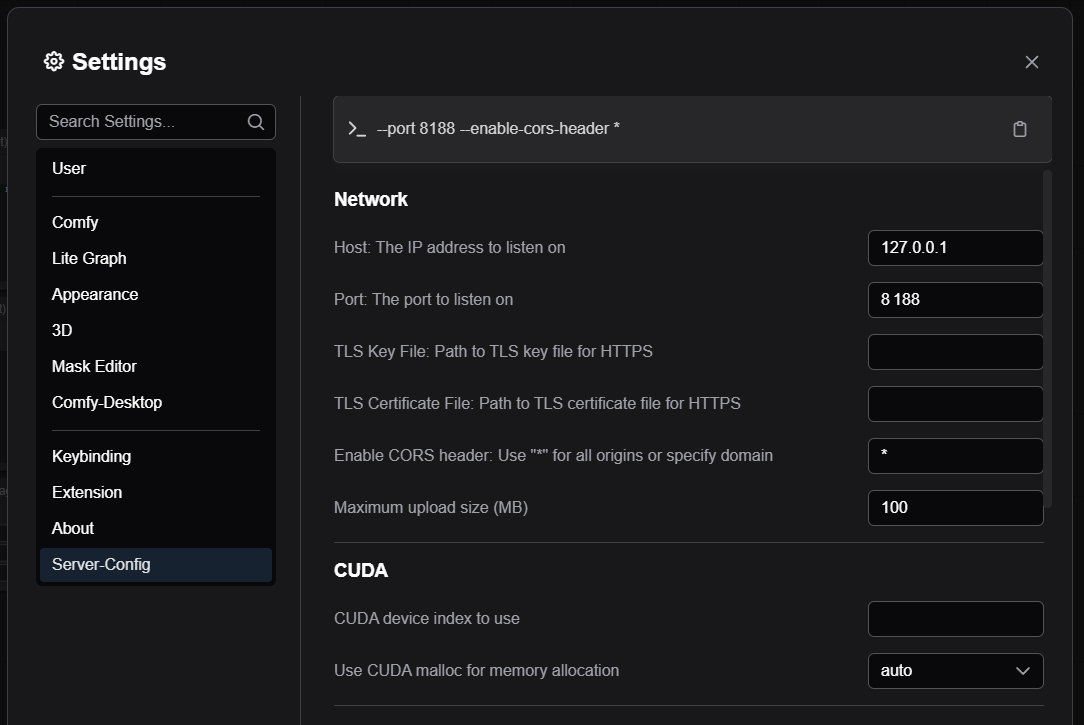
For Portable version:
Once you've downloaded and installed it, you may need to to enable CORS, otherwise it won't work.
Under Windows: open the file you're using to launch ComfyUI with Notepad (e.g. “run_nvidia_gpu.bat”) and add “--enable-cors-header *” to the command line. See the image below:
Run ComfyUI (For portable version, on windows launch run_nvidia_gpu.bat)
Download and run a model
Now you need a model to generate the images.
Eudaimonia's live image generation has been designed and developed around Pony models and its variants. I may add more options later, but Pony is just the best and easiest to work with.
Anime or Realistic?
It's way more consistent and easier (and less likely to generate monstrosity) to generate anime pictures (especially for NSFW/pornographic content) than realistic models. So I would advise to use anime settings.
But if you want to have realistic characters, you can go with PonyRealistic which is working very decently.
To get the model go to CivitAI and create an account. Make sure to set the PG filter (trust me).
Once it's downloaded, place the file in to ComfyUI's folder named: models/checkpoints/
List of recommanded models for ILLUSTRIOUS (anime):
List of recommanded models for ILLUSTRIOUS (realistic):
List of recommanded models for PONY (anime):
List of recommanded models for PONY (realism) generation:
This is not an exhaustive list, feel free to test any other model
IMPORTANT FOR: Big love models (realistic):
Big love models are a bit different, they can generate very realistic images at light speed. There are 2 different versions: SDXL and pony. Both works with SDXL & Pony Loras.
Check the models page for the settings (steps: 8, CFG: 1 to 1.5).
To be able to use the biglove model, you'll have to download the following Lora (dmd2_sdxl_4step_lora_fp16.safetensors) to your loras folder.
Z-Image TURBO (realistic - versatile):
Z-Image Turbo uses a different base model than the others and requires a few specific elements to work properly. Here’s a short guide to help you get started quickly.
Z-Image Turbo is a bit heavier than SDXL models (such as Pony or Illustrious) and may not run on all systems. A GPU with at least 12 GB of VRAM is recommended.
Download the FP8 version of the model from here and place it in the /models/diffusion_models/ folder of ComfyUI.
From this Hugging Face repository, Download:
- The clip model: "qwen3_4b_fp8_scaled.safetensors" and place it to the /models/clip/ folder.
- And the VAE: "ae.safetensors", then place it to the /models/vae/ folder.
The recommended parameters for Z-Image turbe are:
- 8-9 Steps
- 1-2 CFG
- Euler Ancestral / Dpm++ 2M as sampler
- Beta as scheduler
You can experiment with different settings, especially if you’re using a fine-tuned version of the base model. In that case, be sure to check the model’s page for the recommended configuration.
Heavy models on a small GPU: quantized versions
The newer base models (Krea 2, Anima, Z-Image) are much bigger than the SDXL family (Pony, Illustrious). In their original precision they simply won't fit in 8-12 GB of VRAM. Two things make them usable anyway.
1. Always take the Turbo version
Turbo (distilled) variants generate in 8-12 steps at CFG 1 instead of 25-35 steps — roughly 3 to 4 times faster for a very small quality cost. Whenever a model exists in a Turbo flavour, start with that one.
2. Take a quantized version of the model
Quantization stores the model's weights on fewer bits, which shrinks the file and the VRAM it occupies. On CivitAI, many model pages ship several variants of the same checkpoint: unfold the Download panel (the arrow on the right) to see them.
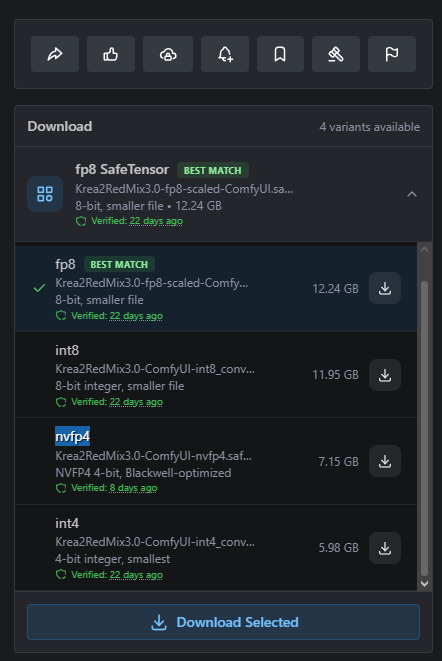
Same model, different precisions (sizes below are the example above):
- fp8 / int8 (~12 GB) — 8-bit. The best quality after the original, quality loss is nearly invisible. Comfortable from 16 GB of VRAM.
- nvfp4 (~7 GB) — 4-bit optimized for RTX 50xx (Blackwell), where it's both small and fast. On a 30xx/40xx card, support depends on your ComfyUI version: it may run slowly, or be converted back at load time and lose part of the VRAM benefit. Try it, and fall back to int4 if it misbehaves.
- int4 (~6 GB) — 4-bit, the smallest. Runs on any card, but it's also the biggest quality hit.
Rule of thumb: pick the largest variant that fits your VRAM with room to spare — count roughly 2 GB on top of the file itself for the latents, the VAE and whatever your desktop is already using.
3. Quantize the clip (text encoder) too
This is the part people forget. These models don't use the small SDXL text encoder anymore: Krea 2 uses a 4B model (qwen3vl), which weighs around 4 GB in fp8. ComfyUI has to load it for every prompt — if it doesn't fit next to the model, it gets shuffled in and out of system RAM and every single generation pays that transfer.
So look for an int4 / nvfp4 version of the clip (usually in the same Hugging Face repository or on the model's CivitAI page) and place it in models/text_encoders/. It roughly halves that cost.
The VAE, on the other hand, is tiny (~300 MB) and very sensitive: leave it in its original precision, never quantize it.
Please read this before you download 12 GB
- Quality does go down. int8 is almost invisible, nvfp4 becomes visible on details (hands, faces, small text), int4 is clearly visible: softer rendering, more anatomy mistakes, weaker prompt adherence.
- LoRAs suffer more than the model itself. That includes your character LoRAs — which is exactly what gives you a consistent character from one image to the next. If consistency matters more to you than the base model's raw quality, an Illustrious checkpoint in full precision will often serve you better than Krea 2 in int4.
- 12 GB stays tight, even in int4. Expect ComfyUI to offload to system RAM (slower first generation, then it settles). 32 GB of system RAM is strongly recommended. If a generation takes more than ~30s, the session won't keep up: go back to an SDXL/Illustrious model, or switch to the Online mode.
Being honest with you: on 8-12 GB, Illustrious (or Anima with its Turbo LoRA) remains the sweet spot for this app. A quantized Krea 2 is worth the trouble if you specifically want its prompt understanding and you accept the trade-offs above.
I need a character
Last thing you want to get is a character to play with. For this, you'll need a character LORA which you can find on CivitAI. Go to this page and filter the models by model's type: Lora or Dora and Base model: Pony.
There are a lot of anime characters, and it will be harder to find realistic ones. But you can use an anime character with Pony Realistic. Quality can vary considerably, so don't hesitate to try out several.
Download the Lora you like, then place it into ComfyUI's folder: models/loras/
Settings in Eudaimonia
Generation settings
Now you need to fill some settings directly in Eudaimonia. Click the cog icon at the top right.
At the very least, you need to fill in the checkpoint path. For example, if you downloaded 'Prefect Pony XL' and moved it in "models/checkpoints", just copy the full file's name of the model into the checkpoint field (eg: prefectPonyXL_v40.safetensors).
Other settings are fine by default.
Character creation
You're now ready to create your first Eudaimonia character. Click on the pencil icon in the top right corner.
You'll need to fill the lora's path, which means that if you downloaded then placed the character Lora in "models/loras/" just copy its file's name into this field.
Then you'll need to fill the triggers. Those are keywords you can find on the Lora's page, which are used to trigger the character and his outfit in the prompt. Just copy them into the fields.
For example:
You want to play with Yor Briar from this Lora
Trigger words are showing in the description
The character trigger words are: "yor briar, black hair, red eyes, earrings, white hairband, hairband, long hair, sidelocks" (don't add "1girl" tag, eudaimonia already handles this.)
And to get her dress outfit: "dress, cleavage, bare shoulders, jewelry, collarbone, sleeveless, black dress, halterneck" (as "white hairband, hairband" already appears in character trigger words)
Other fields are options to customize your character, fill as you want.
Face Detailer
Improve face's quality (recommanded)
As I've said before, it's harder to get consistent quality generations for realistic characters. One thing you can do to improve the quality is to select the option 'Face Detailer' to improve the generated faces.
Enabling this option will increase the generation time, make sure it's still decent (under 10-12s)For this option to work, you must also install the following two comfyui nodes:
Then you have to download the following model and place it in "ComfyUI/models/ultralytics/bbox"
Ultralytics face detection model
If an error occurs when you try to generate with facedetailer on, you probably need to download the face_yolov8m.pt model.
You can find face_yolov8m.pt on huggingface.
Then place it in: "ComfyUI_windows_portable\ComfyUI\models\ultralytics\bbox\face_yolov8m.pt" (create the folder if they don't exist).
If ComfyUI is running and all settings valid, click the CREATE button
Wait for the generation to end, then save the character.
Fillers images
Once your character is created you will have to generate few images that will be used as fillers during a session. During a session, sometimes it's not possible to generate the image in time, so one of these fillers images will be used as an adequate placeholder.
Generate all fillers, regen the ones you don't like, then pick 6 of them.
Save, then you're set to play with this character!
You can regenerate new fillers by clicking 'Manage fillers' button on your character card. If you update your character, make sure to regenerate them.
Realistic generation:
As explained before I heavily recommend using face detailer.
And you can read this article from the creator of PonyRealism to improve the quality.
LORA
Lora is just a small model trained on a specific task. There are multiple type of loras: for styles, characters, outfits, specific actions, etc.
Once you've found a character LORA you like, I suggest you check its page and the recommanded strength. 1 strength is common, but some LORA might be overtrained so a lower value can help increase the overall quality of image.
Higher strength means the character takes more importance in the generation process, while a lower strength will probably lead to a loss of consistency.